The Good Developer
May 2026
Michael Tessler
Building Ideals
By Frances Anderton for FORT: LA
Key Buildings: Isabel & Fig
Most Annoying City Code/Tax/Department: LADBS: the lack of coordination/communication between Plan Check and Field Inspection units
Best Amenity: Exterior awnings
Favorite Construction Site Sandwich: Bub and Grandma’s tuna sandwich
Fantasy Building Name: Biosphere 3
LA Developer Hero: Lois Arkin, LA Ecovillage
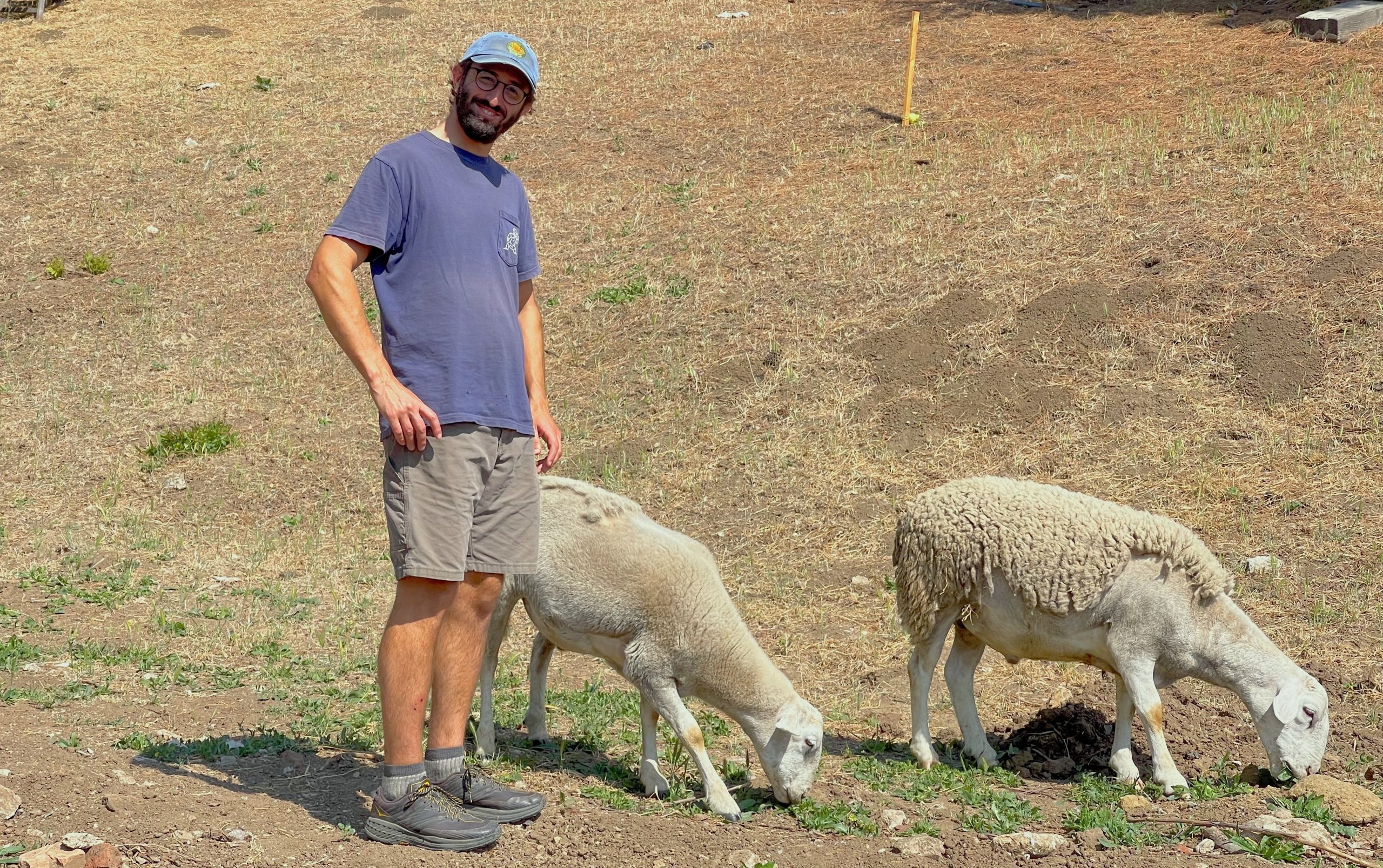
A philosopher isn’t the profession that first comes to mind when one thinks of a developer but that’s the impression one gets on meeting Michael Tessler, a young builder of sustainable “Responsive Homes,” who is on a “sabbatical” from development as he contemplates a move into cooperative multifamily housing. While on hiatus, he has turned over some of the land he owns to the simple life: sheep-grazing and viticulture!
But he has plenty to say about the nature of development and the challenges involved in creating buildings that last several lifetimes, use passive instead of mechanical cooling and heating, and make sense in the marketplace.
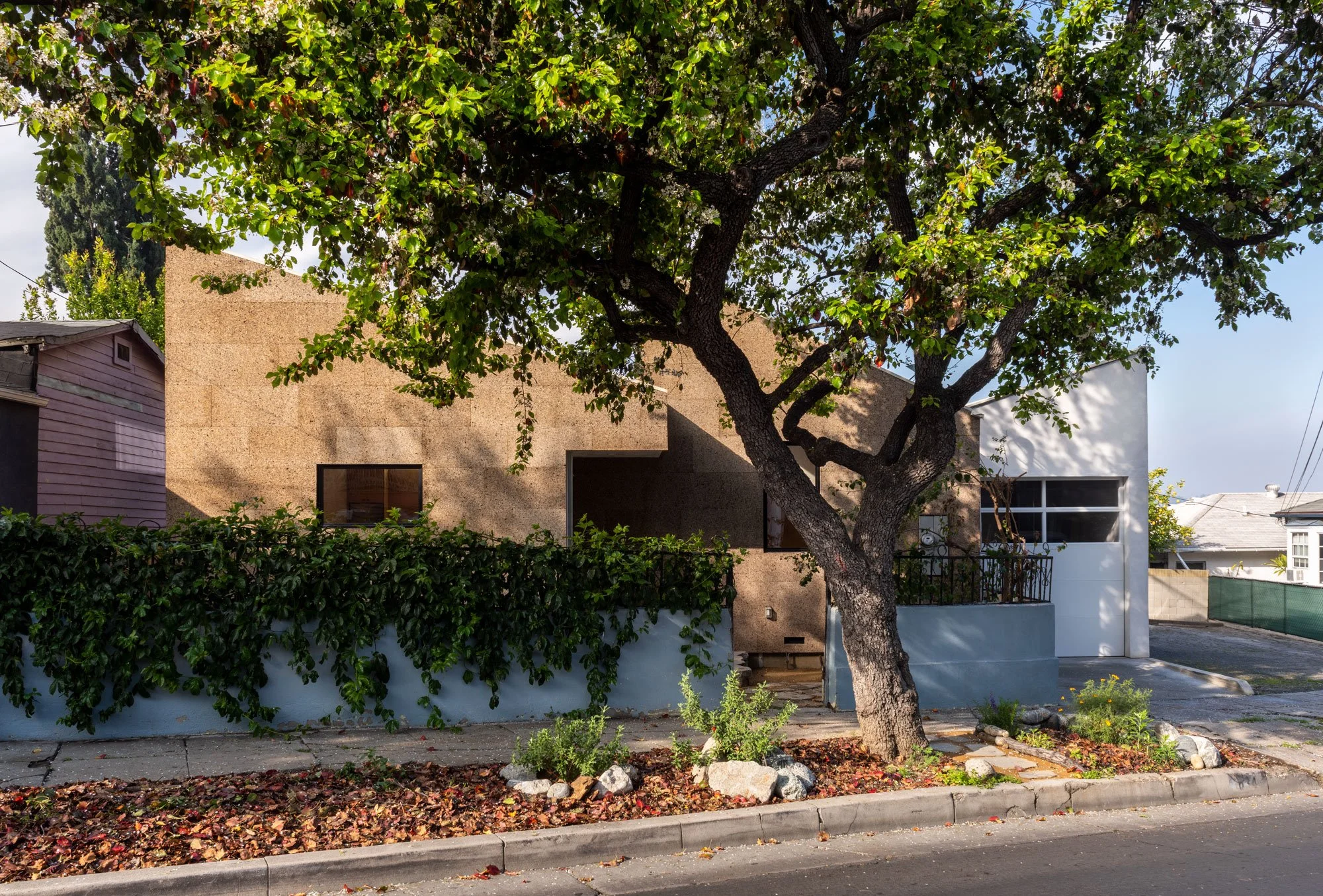
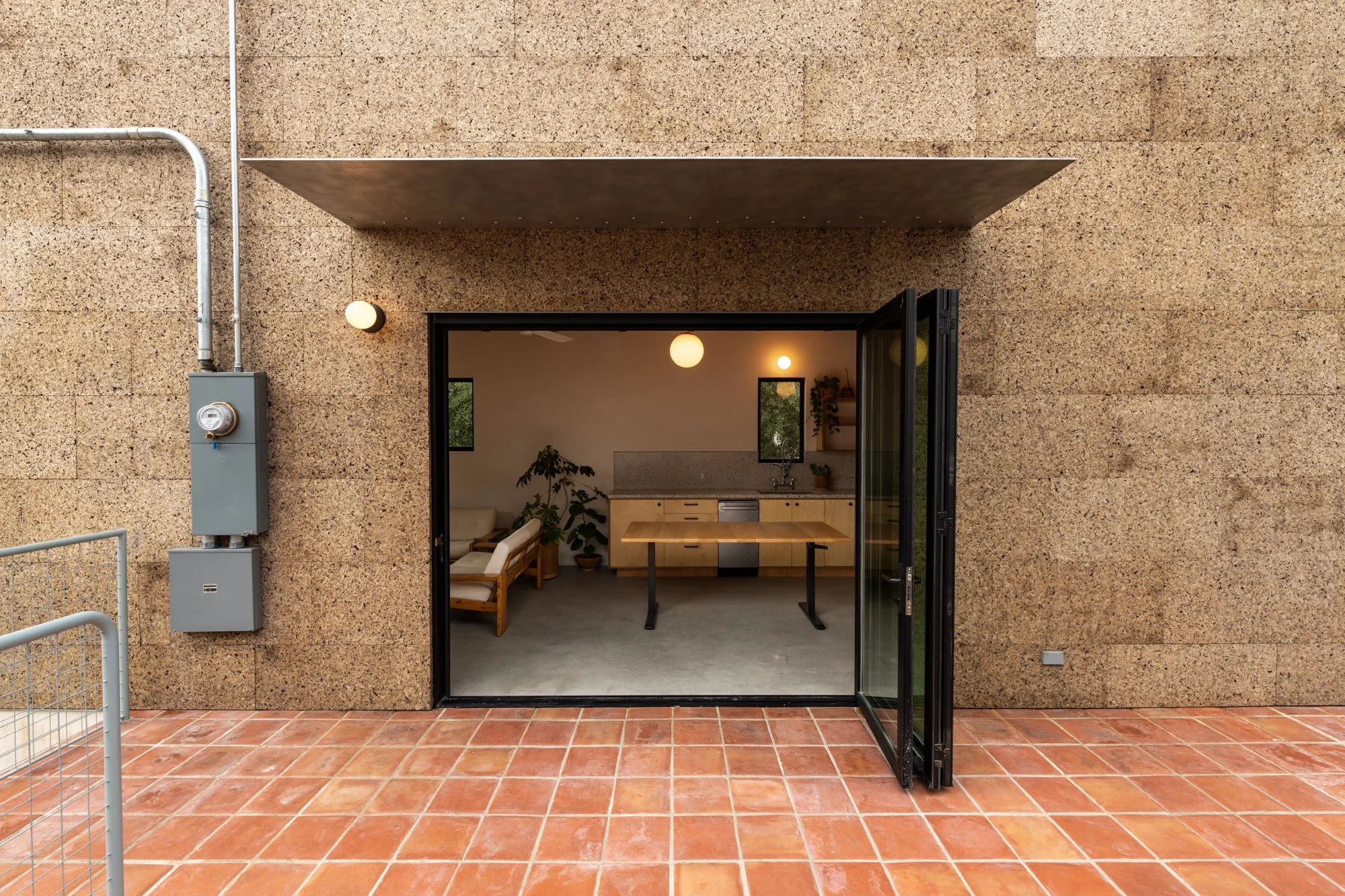
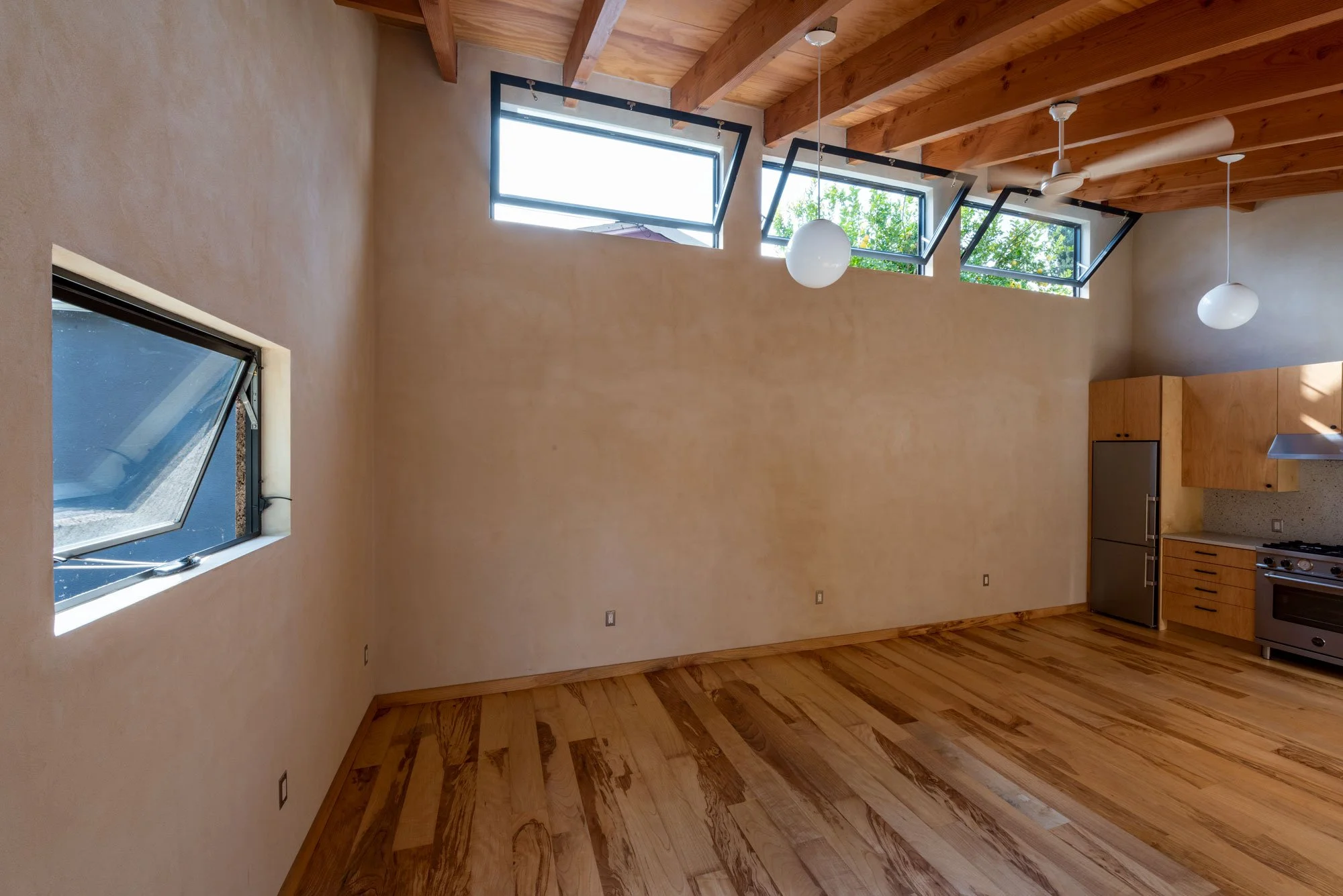
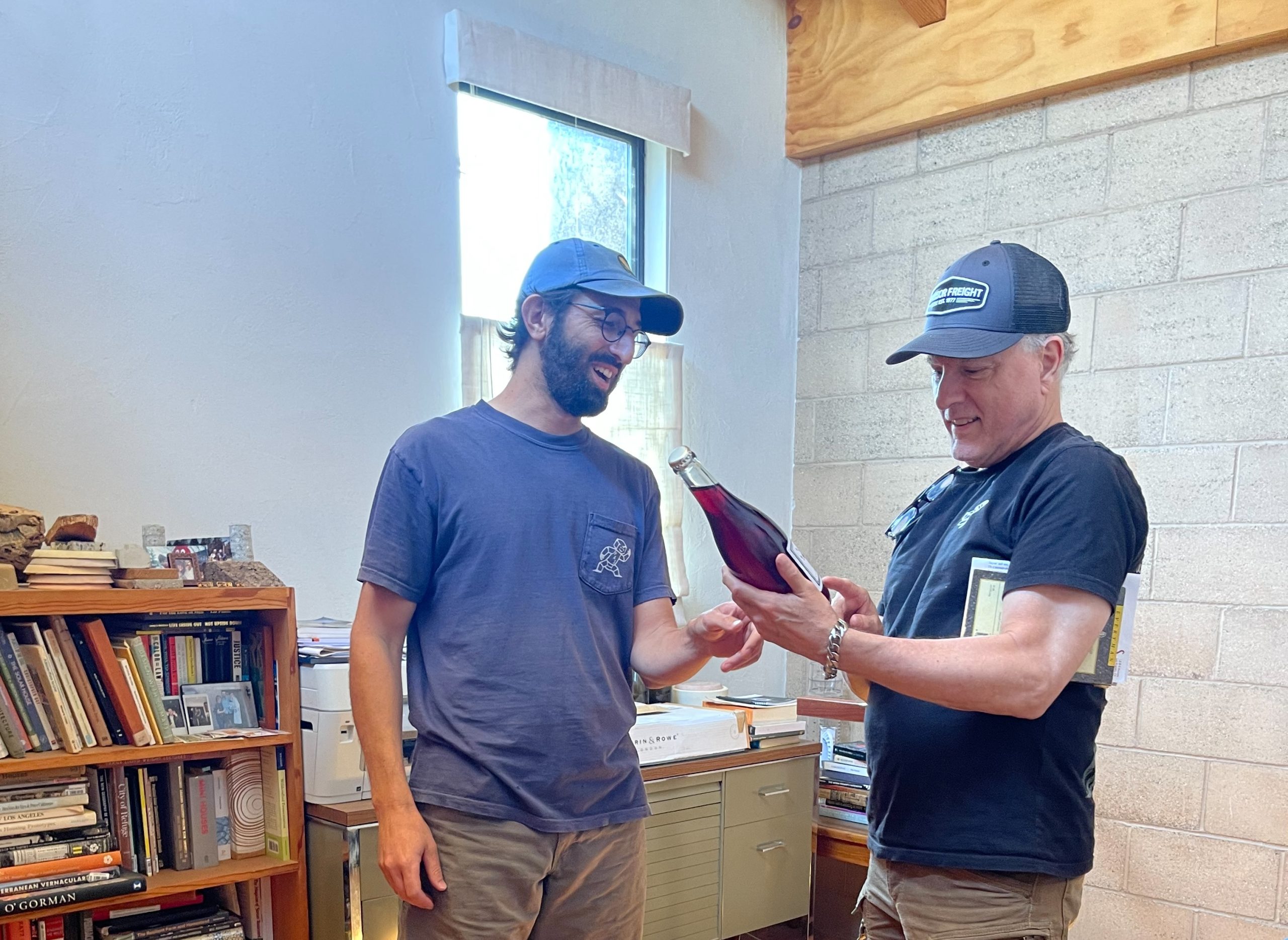
FORT: LA met Tessler at his Isabel house in Mount Washington, on a tight 1700 square foot lot on Isabel Street. With houses so close that opening up the structure to the sun and breezes was impossible, Tessler and his architect Daveed Kapoor figured out a custom design that could meet his aspiration for zero energy use: a cork-clad, barn-like building surrounded by unmanicured foliage, with a sawtooth silhouette thanks to the high ceilinged interior with openable clerestory windows that let out rising hot air, shaded by a retractable canopy on the exterior.
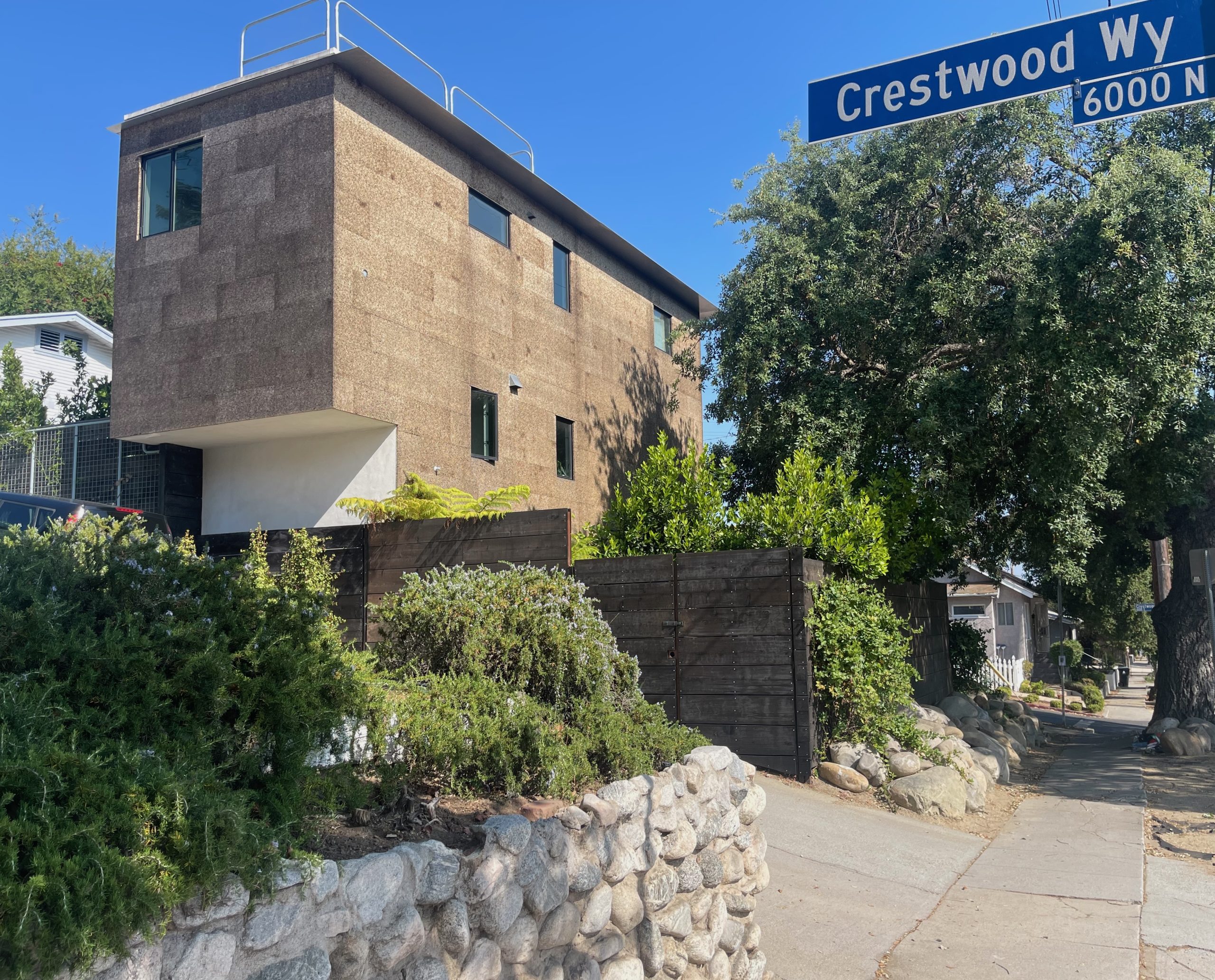
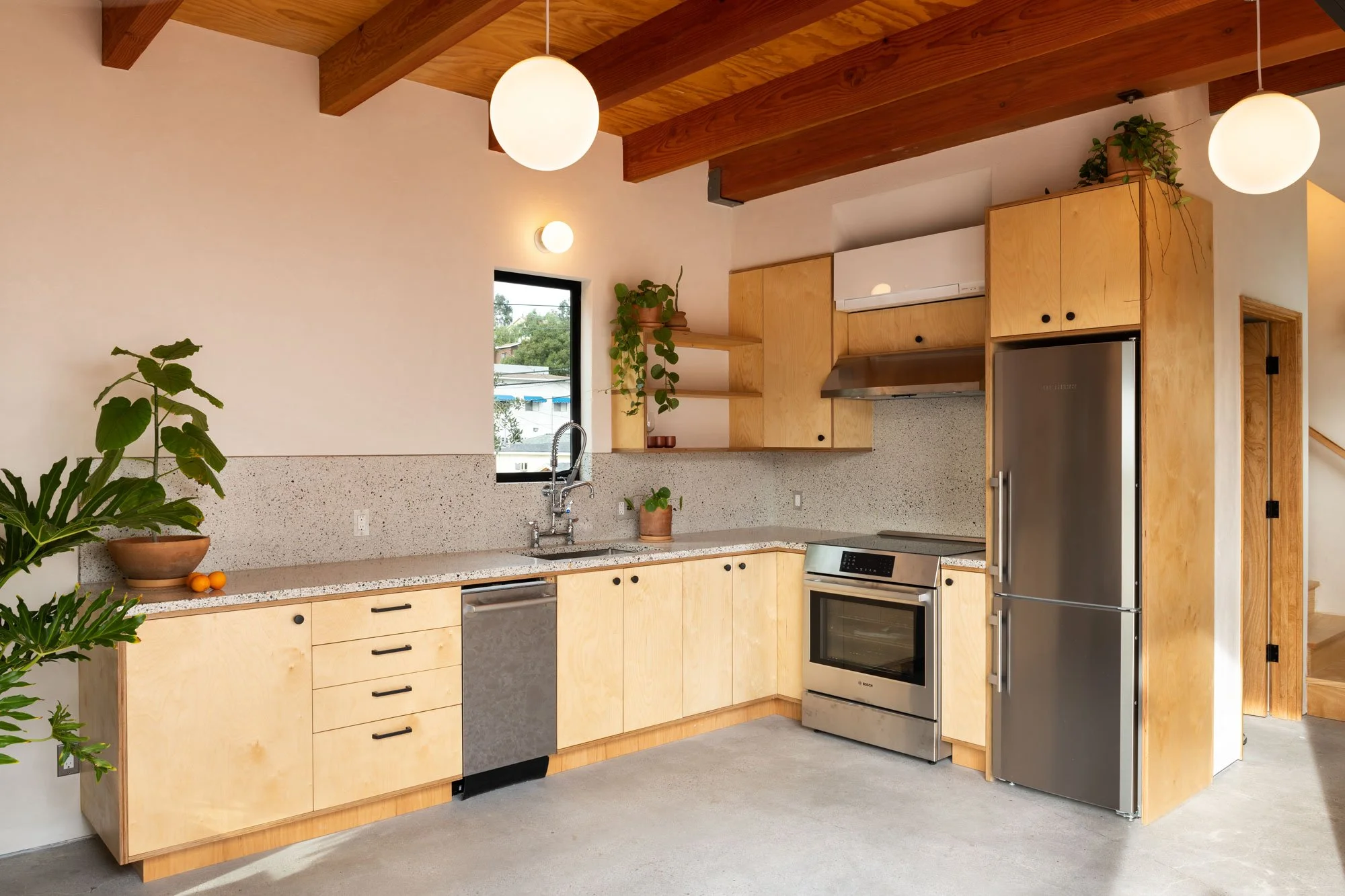
Calming interior spaces are built of exposed but warm materials; cabinets, floors and furniture made of lumber from fallen trees sourced by Angel City Lumber. In place of cement block, walls are made of rammed earth bricks and counters of Terrazzo dotted with minerals sourced from the Los Angeles River: rock, shell, glass, plastic, concrete, brick, ceramic, asphalt, metal, and bone. After building this house, he applied the same approach to Fig, a property on Figueroa at Crestwood Way in Highland Park.
Tessler is not alone among developers taking a break right now. A good number will tell you that currently they are in a state of wait-and-see. They confront so many roadblocks – tariffs, high interest rates, costly labor and materials, linkage fees and transfer taxes like Measure ULA, a pending election, red tape and policy measures in flux (SB 79, upzoning areas close to mass transit, takes effect on July 1st) — that projects are on hold, ideas gestating. But few have diverged into agriculture.
With a contemplativeness that makes him seem more “Good Shepherd” than “Good Developer,” Tessler shared his journey from real estate studies to the “appropriate technology movement,” and his vision for durable, community-focused housing. As he applies his sheep manure to gardening and ponders selling mulberries and figs locally, he has much to say about development for a young idealist getting into the field. He reflects on lessons from permaculture, how cities are shaped by spreadsheets, and why losing money on a house he built was as worthwhile a lesson as sinking dollars into a real estate degree.
The Good Words
Frances Anderton
How long have you been living here, in Isabel house?
Michael Tessler
I finished construction end of 2018 but my permits were revoked, due to the (process of approving the) cork, and I received the final permit 3 years later.
FA
And why did you put the cork on the exterior?
MT
Exterior insulation is far and away better than having it inside your walls. Outside of your walls is best; before the heat gets in, before the cool gets in.
The house has a focus on passive cooling and heating and you can achieve both of those pretty much in the same way, and that’s by orienting your windows and your building south. So, how do you do that in an urban infill context?
It’s 90 degrees during the day as a high and it’s low 60s at night, so you open the metal screen door and then hot air rises (and exits the clerestories) and you have natural ventilation that, by a process known as stack ventilation, creates a pressure differential, brings in the cool air from the night, exhausts out the hot air of the day. So basically, you open up the entire structure at night, you get all of that cold air in, absorbing into the thermal mass of all the materials, and you close everything up when you leave for work. So that does require occupant participation, it requires a ritual, a different perspective on how you use a house in America. But I’ve only had to use the heating or cooling about 25 hours in the past eight months.
FA
What brought you to this? Why did you decide that you were so committed to sustainable development?
MT
I started in a more kind of traditional real estate brokerage, right out of college. I was teaching in an after-school summer music program in a middle school in Boyle Heights, and I basically just cold-called this real estate office that I was passing by to and from the school. They taught me a lot, about what not to do. In the process of being with them, I had a little bit of a crisis of conscience, and I moved up to Northern California.
I grew up in Los Angeles, I went to UCLA, I was 25 at the time, and I said, okay, the only noble profession in the world is agriculture. So I studied permaculture. I volunteered with a very amazing permaculture design center up in west Sonoma County — Occidental Arts and Ecology Center — and I learned a lot about gardening, permaculture thinking, closed loop systems, stacking functions.
And I said, okay, if I move back to Los Angeles, I’m going to fuse this idea of permaculture with architecture, construction, and development. I wasn’t sure what that looked like yet, but Sim Van Der Ryn (State Architect for Governor Jerry Brown in the late 1970s; he designed and built the State’s first energy efficient and climate-responsive building) designed a lot of the structures at the Permaculture Design Center and I met him at his house in Inverness, and we had just one afternoon of a conversation, and it really inspired me very, very deeply. I said, “Should I go back and get an architecture degree? He said, ‘Absolutely not. Teach yourself how to draw, whether it’s on paper or in a program, design something and hire a structural engineer, and you’ll learn more than you ever will in school.’ He was part of that whole appropriate technology movement of the late 1970s in California, using local materials – The Integral Urban House (a pioneering 1970s experiment in self-reliant urban homesteading) – and so when I came back here, I was like, okay, climate responsive development, Responsive Homes.
That was the idea, but I needed to know more about real estate development. What are the mechanisms? What’s the most capitalist, private equity focused, conventional program in California? USC. I mean, USC is the belly of the beast, but it turns out that the head of the Lusk Center, Richard Green, is an absolute genius of urban economics, real estate thinking, and so it really opened my eyes. There were a lot of amazing speakers. I couldn’t have asked for a more enlightening look into how the world works. First and foremost, what you learn is the language of spreadsheets and cash flow analysis, and this is how cities are designed. Cities are not designed by architects or planners, and they’re not designed by politicians. They are designed by and large by developers.
FA
So you had this education, which sounds really interesting.
MT
I was fascinated, trying to understand how someone with that kind of money and power would do a building with natural materials that is passively designed, community focused. And as I was finishing the program, COVID happened, and I was mid-construction on the Fig House. We slowed down the project in response.. then it finished, and I finished the masters, all at the end of 2021. At beginning of 2022 I sold the house, and I lost money.
FA
Sorry to hear that.
MT
But no, it was the same amount as my masters. You know, people don’t talk about losing money in their master’s degree. It’s just that I did two masters degrees at the same time. The house was just as enlightening for a very different reason, being that you can design a great building, and it can be beautiful and well built, but at the end of the day, you have to compete with all of the other people that have their building on the market, and in order to sell your building you’re reliant on the structure of financing, where people’s down payments come from, and how people get financed.
I’m not going to fault the system. I made mistakes. I probably shouldn’t have started a project like that on Figueroa, on a corner, with no yard. If they’re going to spend over a million dollars in Los Angeles, people want to have a backyard for the dogs, they want to have a quiet area. So that was a market misjudgment on my part. But what I realized is people were comparing this new construction house with the flipped houses down the street. Corey Ruppert, the GC, and I built that house with 4×4 (studs) instead of 2×4 and the electrical wiring is in flex conduit, which is not only more durable but future-proof. It was very well insulated, and everything was handmade – custom millwork, casework and LA River Terrazzo countertops. But no amount of durable construction or artisanal craft is as important as the location and setting of the building.
FA
You’re talking about maintenance and durability, and that’s not something people can immediately see the benefit of.
MT
Absolutely. People aren’t seeing what’s inside of the walls, they’re seeing what the surfaces are. But I realized that if I am going to do development, I’m going to do it in this no-compromise way, and see if it works, almost as like a case study of a life pursuit, and then if it doesn’t work, at least I tried, and at least I know what doesn’t work about it.
FA
So where did you land?
MT
I want to clarify I have zero regrets, because what we did with that house I’m still proud of to this day, and you know, no one would ever attempt to build such a house in terms of material quality, sensitivity, and durability. I know that we didn’t cut corners, and I know that we built it to the best of our ability, but the logical next step of my company is to build a 10-unit building; I have a pipeline of vacant lots: small urban infill parking lots that would be appropriate for five, eight, 10-unit buildings. It’s one thing to lose $125,000 on a single home, but multiply that loss by five, eight, 10, that’s too much of a sacrifice.
But I came to the conclusion that my next project had to be multifamily, had to be urban infill, dense, but beautiful. All passive design, natural materials, and then how do you build that, and, who buys it? Do you sell them as condos? I mean, it’s the same problem for the for-sale model as for rental; it’s on the open marketplace, and the marketplace does not value durability.
FA
So you currently own these parking lots, and you’re figuring out what to do with them.
MT
Well, they are rented, one of them is rented to an asphalt company, one is rented to a moving company, and they don’t make that much, but they make more than I would stand to make spending five years developing multifamily or another building type, and then trying to sell. But you know, we should be building on all the flat, infill spaces that we do have, all the parking lots and many of the backyards. Obviously ADUs have been the biggest, most successful way of creating housing, new housing in a generation.
FA
Isn’t that because it was the one prohousing policy that has benefited existing homeowners?
MT
Yes, and it just so happens that single family homes are inherently the simplest product type to build. Anyone that watches HGTV with enough money for a down payment can flip a single family home. Anyone with a little bit of fortitude can build an ADU. Yes, you do need an architect, but it’s much easier than a mom and pop building a four-unit building or a 10-unit building.
I came to the realization that for me the only way forward is to develop multifamily for a client that will own it indefinitely. Until there are long-term property owners in Los Angeles, we will not have homes, multifamily buildings, commercial buildings, new construction that are built well with beautiful materials, beautiful architecture, because all of that costs more upfront and takes many more years to see a return.
FA
So you have parking lots, but then you’ve got a vineyard.
MT
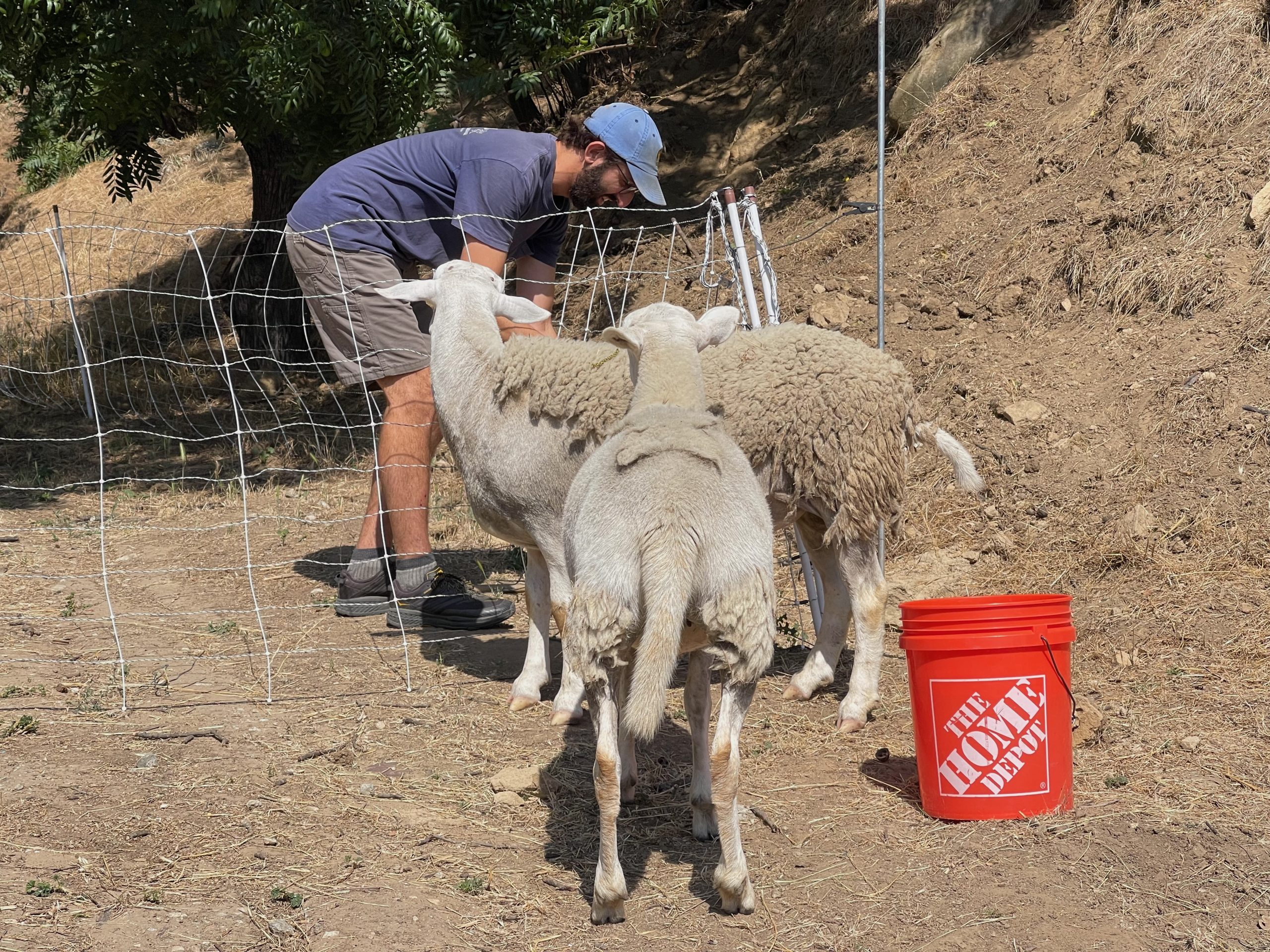
Well, the vineyard project. So, after the Highland Park project, I had a mixed bag of success and failure, and it seemed like a very logical place to end a chapter and start a new one, and I am very interested in agriculture and wine-making really called to me. During the pandemic I was – like a lot of people – drinking a lot of wine, and my friend Brian was telling me about this movement of people doing agriculture and wine making in Europe and California and all around the world, working with ancestral techniques. Many of my favorite people in wine-making are basically philosophers, and I was so attracted to their ideas and so I jumped in with my friend Riley O’Neill Latta who has a small, 2000 square foot winery in Pasadena, and he was farming some vineyards in Anza, in the high desert, 3000 foot elevation, and I just got the bug, working the land and working in the cellar and doing harvests. Then, down the street from me, I found an acre and a quarter that has been denuded of all the native vegetation, and I bought it from the guy who was about to lose it to a property tax auction (where properties are sold to recoup back taxes). And here was my chance to do a fusion of viticulture orcharding and habitat restoration. Then the fires happened, so I got sheep, and so now I have three sheep on this hillside.
FA
So I hate to pour rain on the parade, but have you been reading those articles about how people are drinking less wine these days?
MT
Yes, honestly, I welcome that because the vast majority of wine that exists in California is to me a disgrace.
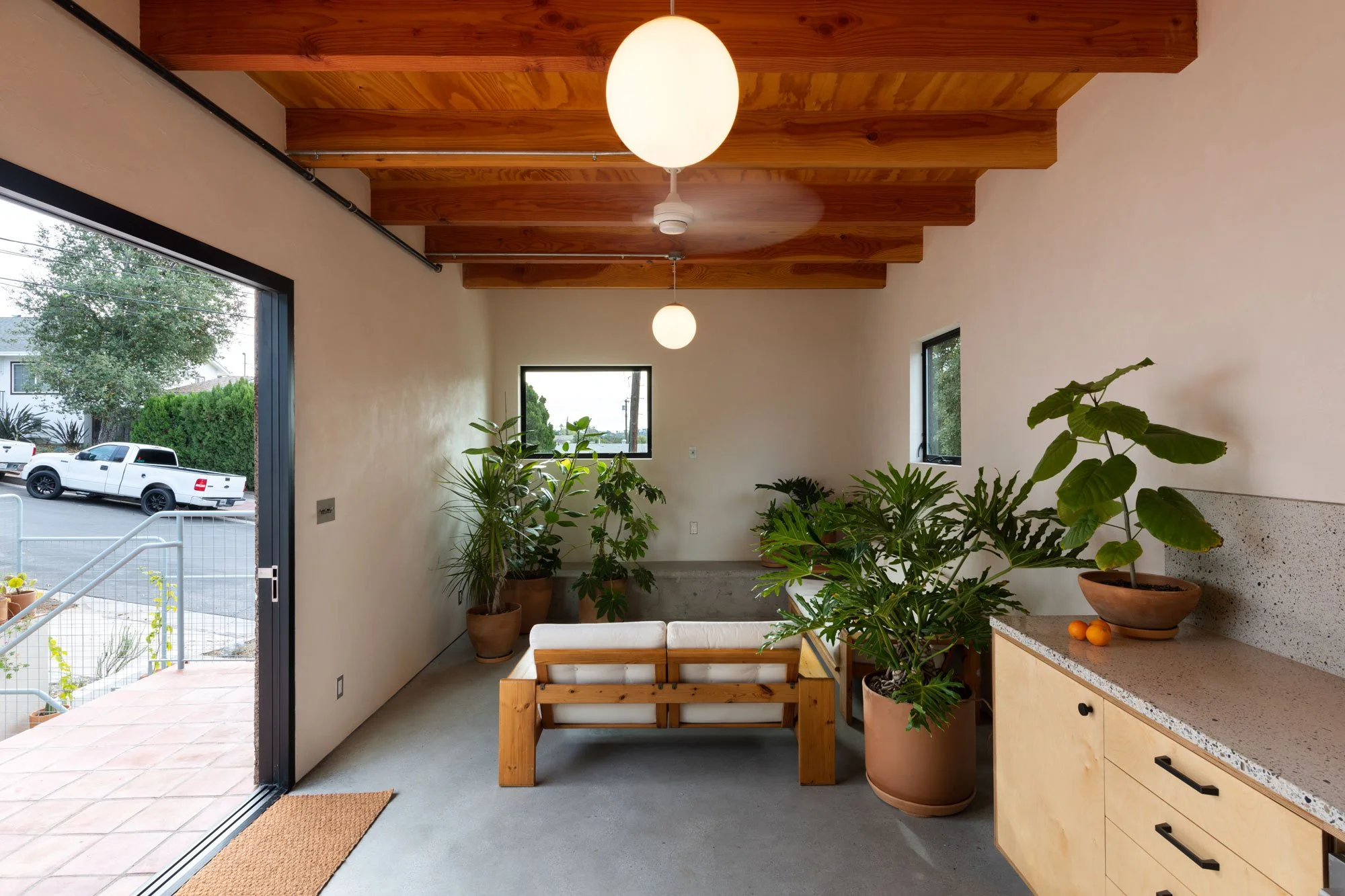
At this stage in the conversation Tessler explained the challenges of making wine from Grenache grapes he sourced from a ranch in Mendocino, and shows off his bottles of 2023 wine, that he says has a tannin structure that is still softening and could use some more time before being opened. The bottle is clear, with a woodcut print label designed by Tessler’s friend Nik Gelormino. He picks up a piece of raw cork from his bookshelf…
FA
So there’s a connection to the cork walls?
MT
So the highest and best use for cork is the wine stopper, but then what happens to the rest of the bark? The bark regrows on the tree every nine years, and the most valuable cork comes from trees that are 40 years old and above, so it might be the biggest agroforestry industry that is focused on preserving old trees, not cutting them down. You can only get this material from the oldest trees, and they live for 250 years. 2 million hectares of land in Portugal are these ancient cork forests.
After viewing the wine bottles we walked together to view another parcel of Tessler’s land, on a steep hillside close to his home.
MT
On the county parcel map, there’s about 150 different single family shaped lots – 50 x 120, or 50 x 100 – and some are oddly shaped, but you know they just go up the hillside with paper streets, connected with a roadway up that will never be built up in this hill. So you have a lot of public space in the form of unbuilt roadways, and then you have single family parcel-sized lots that are all owned by different private owners.
So this lot is not mine, this is another neighbor named Steve Appleton, of LA River Kayak Safari. So I bought an acre and a quarter up here on the ridge on this, and I contacted Steve. He knows a lot about architecture, and I said, “What do you think about sheep? And he said, “Yeah, sheep, that’s a good idea.”
Tessler connected with a shepherding outfit based in Ojai, and got himself three sheep that he named Seamus, Shaq, and Shalom. On his arrival, they bound down the hill to be released from his field into the neighboring one.
MT
So they just nibble on the weeds, and ironically, because of brush clearance, there is less for them to eat at the moment.
FA
So is this the good developer as good shepherd, who gives up on building and goes back to the land?
MT
I’m calling it a sabbatical. I can see myself getting back into it. It just needs to be done a certain way. I can’t consciously build how other multifamily developers do – Type 5 over podium parking, stucco boxes ignorant of orientation and place, relying on mechanical systems to make the interior livable. The only way I can envision getting to this idea of durable, beautiful, community-focused, natural buildings, other than (very unlikely) public subsidies, is for a client or customer with an indefinite hold period. This client is either a rich, benevolent, angel investor willing to own a meaningful building and make 2-3% return year over year, or more likely it’s a Community Land Trust (CLT). And to me, a Community Land Trust is by far and away the more compelling option.
FA
So you’re thinking about creating one?
MT
Partnering with one at least. That’s where I landed at the end of my master’s degree. But as of four years ago, there wasn’t public money for CLT’s to do new development. There was money for them to buy existing multifamily, to take them off the speculative market. It’s a sort of triage in my opinion, to prevent people from getting evicted; but it doesn’t begin to solve the underlying housing scarcity problem. (We need) a funding mechanism for Community Land Trusts to build new, or partner with developers to build new, and for the city or county to support and subsidize it. But for an entity that knows it will never sell a building — only they can justify the additional up-front investment in order to realize the long-term value of a durable building, which not only costs less to maintain on a yearly basis, but incurs far less in capital expenditures and renovation costs in, over let’s say, 100 years.
FA
Well, good luck. You are clearly an enlightened thinker.
MT
I appreciate that. Thank you. I don’t know if I feel enlightened most days, but when I’m with the sheep, I do. I’m sure sheep are really the enlightened ones.
Read about our other Good Developers, Joe Sharaf, Bridget Wexman, Aaron Van Schaik, Cameron Hassid, and the Introduction to the year-long series.